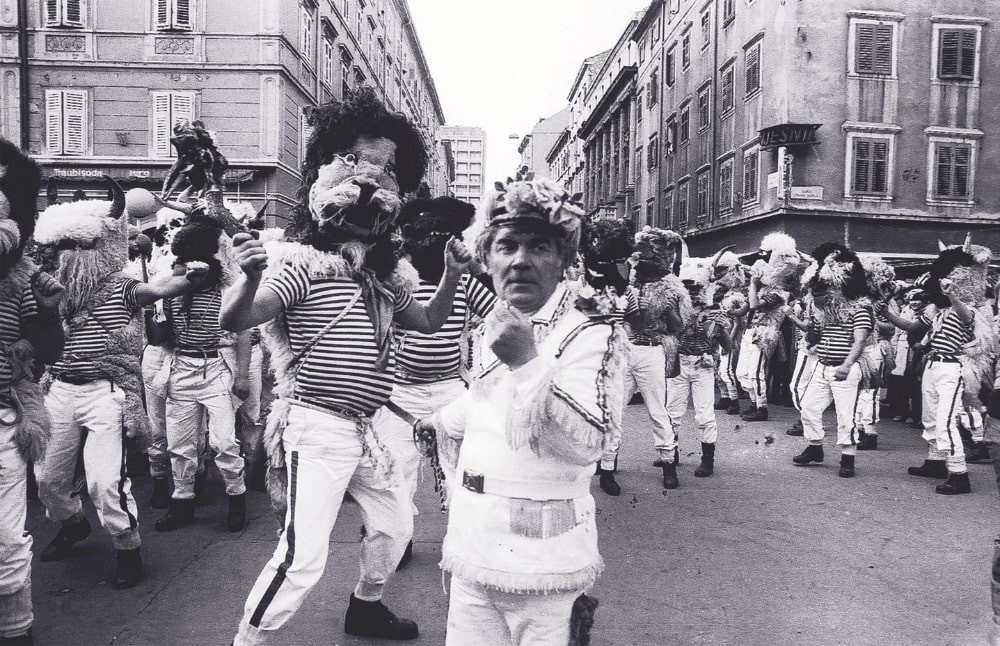
Krepat, ma ne molat!” (“Die, but never give up!”) is the motto that best sums up everything the Rijeka Carnival stands for. Despite its long history, the Carnival’s joyful, defiant, uninhibited and critical spirit shows not the slightest sign of fatigue. Instead, it flourishes and grows year after year, carried forward by new generations of carnival enthusiasts and fuelled by current events as much as by a rich tradition. And that tradition in this region goes back much further than many people realise.
One piece of evidence of the Carnival’s long history—which perhaps comes as no surprise given its critical spirit—is a ban dating back to 1449. This document, an ordinance issued by the City Council, prohibited people from covering their faces with masks, with the exception of guests attending a masked ball at the Castle. Violations were strictly punished. The ordinance sought to maintain public order and prevent people from freely criticising those in power. History, however, shows that the Carnival overcame every obstacle and became, and remains, a celebration of joy, witty and often critical commentary on current events, and an opportunity for everyone to be whoever they wish to be, at least for a little while.
The year 1982 holds special significance for the Rijeka Carnival. It was then that, for the first time, three carnival groups paraded along Korzo, organised by the Tourist Association of the Municipality of Rijeka: Lako ćemo, Pehinarski feštari and Halubajski zvončari. This marked the spark that set things in motion and signalled that the carnival community was ready for something much bigger.
The rest is history. Rooted in the traditional mesopust festivities of the coastal region, the Rijeka Carnival has grown over the years into the most significant carnival celebration in Croatia, with a reputation extending far beyond the country’s borders. What truly makes it special is the “fifth season of the year” it has created—a time when the usual rules and values are turned upside down and the Carnival simply becomes a way of life for the people of this region.
Since the early days of the Rijeka Carnival, the number of participants has grown alongside the number of visitors. From the original three groups, the event has expanded to more than 100 groups, with participant numbers reaching five figures. The crowds of spectators have long since become impossible to count. In addition to those who watch the parade in person, many more follow it on television, while live online broadcasts have brought the Rijeka Carnival closer to audiences around the world.
All of this led to Rijeka becoming a full member of the Federation of European Carnival Cities (FECC) in 1995. The Rijeka Carnival was subsequently included among the Top 500 European Events, named one of the world’s most exotic events by The Sunday Times, and featured in the book 501 Must Be There Events. In 2009, the Rijeka Tourist Board received the “Golden Tourist Heart” award for organising the best tourism event in Southeast Europe.
After years of all kinds of organised and spontaneous carnival celebrations, memorable mishaps and adventures, appearances by famous and historical figures, and even natural disasters, the Rijeka Carnival continues to roll on without stopping, with no fear of ever being forgotten.
The best proof of its enduring spirit is the Children’s Carnival Parade, which follows in the footsteps of the “grand” parade, growing in size and imagination every year. It serves as a breeding ground for new generations of carnival enthusiasts who will carry this tradition into the future.
At the end of the story, only one invitation remains, because the Rijeka Carnival is best experienced in person, on the spot, with all your senses.
Be whoever you want to be! Come to the Rijeka Carnival!
2027
17 January – 10 February 2027
7 February – International Carnival Parade
2028.
17 January – 1 March 2028
27 February – International Carnival Parade
2029.
17 January – 14 February 2029
11 February – International Carnival Parade
2030.
17 January – 6 March 2030
3 March – International Carnival Parade
2031.
17 January – 26 February 2031
23 February – International Carnival Parade
2032.
17 January – 11 February 2032
8 February – International Carnival Parade
2033.
17 January – 2 March 2033
27 February – International Carnival Parade
2034.
17 January – 22 February 2034
19 February – International Carnival Parade
2035.
17 January – 7 February 2035
4 February – International Carnival Parade
2036.
17 January – 27 February 2036
24 February – International Carnival Parade